Carpet Buying Guide for West Michigan Homes: Fiber, Style, Pad, and Installation
- Choose carpet in this order: the room and its traffic, the fiber, the style, the pad, then the installer.
- Nylon and triexta hold up best under traffic. Polyester is soft and resists stains at a lower cost. Wool is the natural premium choice.
- Textured and patterned carpets hide footprints and wear, which suits stairs, halls, and family rooms.
- Face weight, density, and twist only compare fairly between carpets of the same fiber and style.
- Basements and stairs set their own rules for pad and installation, and both are worth deciding before the estimate.
This guide walks through the choices in the order they come up at a kitchen table with samples spread out. It draws on the carpet Freedom Flooring & Design installs across West and Southwest Michigan, including a bedroom in Muskegon and a staircase in Grand Rapids.
In this guide
- How do you choose carpet for a West Michigan home?
- Which carpet fiber holds up best?
- Which carpet style fits which room?
- What do face weight, density, and twist tell you?
- What carpet works on stairs?
- Can carpet go in a Michigan basement?
- What carpet is best with pets and kids?
- What padding goes under the carpet?
- What affects the cost of carpet installation?
- What happens at the estimate and on install day?
- What should you ask a carpet installer?
- How do you care for new carpet?
- Frequently asked questions
How do you choose carpet for a West Michigan home?
Start with the room, then pick the fiber, the style, and the pad in that order. The room decides how much traffic, moisture, and sunlight the carpet will see. The fiber decides how it wears, the style decides how it looks after a year of use, and the pad decides how long both of them last.
The Carpet and Rug Institute frames the same decision around how a room is used: foot traffic, outdoor access, sunlight, and pets. West Michigan adds two local conditions. Lakeshore humidity and slab basements make moisture part of the conversation, and sand, salt, and slush come through the door for much of the year.
Color comes last and is judged at home. A sample looks different under showroom lighting than it does beside your own trim on a gray January afternoon, which is the reason we bring the samples to the house.
Which carpet fiber holds up best?
Nylon and triexta hold up best under daily traffic, and both suit stairs, halls, and family rooms. Polyester feels soft and resists stains at a lower cost and fits bedrooms and lighter-use rooms. Olefin handles moisture and is common in loop carpet, and wool is the natural, premium fiber.
| Fiber | Strength | Trade-off | Where it fits |
|---|---|---|---|
| Nylon | Springs back after traffic and furniture, long track record | Stain protection depends on the treatment applied | Stairs, hallways, family rooms |
| Triexta (Mohawk SmartStrand) | Stain resistance built into the fiber, soft hand, durable | Fewer style choices than nylon in some lines | Homes with pets and kids, living areas |
| Polyester (Mohawk EverStrand) | Soft, colorfast, resists stains, lower cost | Flattens sooner under heavy traffic | Bedrooms, guest rooms, lighter-use spaces |
| Olefin (polypropylene) | Resists moisture and fading | Crushes and holds oily soil | Loop and berber carpet, some basements |
| Wool | Natural fiber, rich look and feel | Higher cost and more care | Formal rooms and bedrooms |
Mohawk is the carpet line we carry most, including SmartStrand and EverStrand, so triexta and polyester are two fibers you can compare side by side in our samples.
Which carpet style fits which room?
Match the style to how the room is used. Plush carpet suits quiet bedrooms and shows every footprint. Textured and frieze carpets hide footprints in family rooms. Loop and berber carpets are low and durable for basements and halls, and patterned carpet disguises wear on stairs.
| Style | How it looks and feels | Works well in | Think twice in |
|---|---|---|---|
| Plush and saxony | Smooth, even, formal, shows footprints and vacuum marks | Bedrooms, formal living rooms | Busy hallways and stairs |
| Textured and frieze | Twisted yarns with a casual surface that hides tracks | Family rooms, hallways, kids’ rooms | Rooms where a formal look is the goal |
| Loop and berber | Low, tight loops with a flat profile | Basements, home offices, rental units | Homes with cats that scratch, as claws can snag loops |
| Patterned (cut and loop) | Cut and looped yarns form a pattern at two heights | Stairs, hallways, dining rooms | Very small rooms where a large pattern gets lost |
What do face weight, density, and twist tell you?
Face weight is the ounces of fiber in a square yard of carpet, density is how tightly that fiber is packed, and twist is how many turns each yarn has per inch. Together they describe how much fiber you are buying and how well it will stand back up, but only within the same fiber and style.
A heavy face weight on a long, loose pile can wear worse than a lighter, denser carpet: tall fibers with room to fall over mat down sooner. Density and twist are the better guides for stairs and hallways. Tight twist keeps the yarn tips from blooming open, which is what makes a carpet look worn before it is worn out.
Ask for the specification sheet of any carpet you are serious about. It lists fiber, face weight, density, and twist in one place, and it lets you compare two carpets in the same style fairly. Comparing a plush polyester against a nylon frieze by face weight alone tells you very little.
What carpet works on stairs?
Stairs call for a dense, low to medium pile carpet in nylon or triexta, installed over a thin, firm pad and wrapped over the nose of every tread. Patterned and textured carpets suit stairs, where they disguise the traffic lane that forms down the middle of a flight over the years.
A Grand Rapids staircase our crew carpeted on November 11, 2026 is a current example. The stair is open on one side, so the carpet is wrapped over each tread nose, turned around the open end of every step, and cut in tight around each baluster where the flight lands on a plank floor.
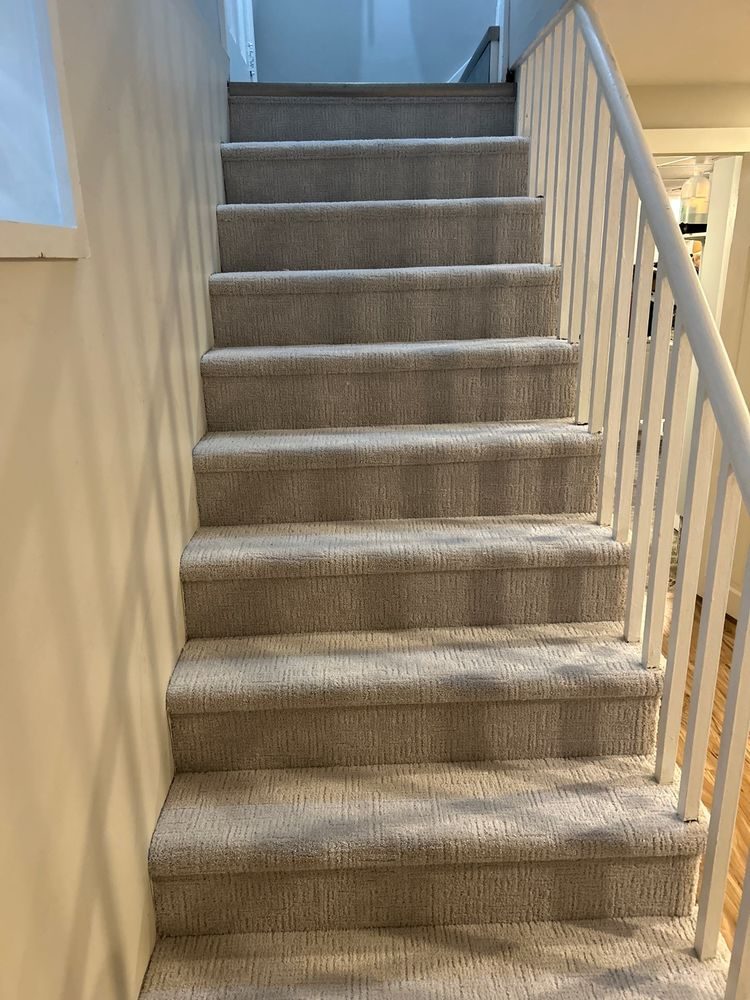
Plank on the main floor with carpet on the stairs is a common pairing in West Michigan homes. Our article on luxury vinyl plank on stairs compares the two materials on a staircase in a table.
Can carpet go in a Michigan basement?
Yes, carpet can go in a Michigan basement when the slab has been tested and is dry. Choose a synthetic fiber, a low pile, and a moisture-barrier pad. In a basement that takes on water or tests damp, waterproof plank is the better floor, with an area rug for warmth.
West Michigan basements sit on concrete that carries ground moisture through the humid months, and older basements were often finished with carpet laid straight over the slab. We check the slab before recommending carpet below grade. Our guide to basement flooring for Michigan homes covers the waterproof options in detail.
What carpet is best with pets and kids?
For pets and kids, choose a stain-resistant fiber such as triexta or a treated nylon in a textured cut pile, and put a moisture-barrier pad under it. Avoid loop carpet with cats, whose claws can catch the loops. A mid-tone, multi-color yarn hides the most between vacuuming days.
The pad matters here as much as the fiber. A spill that reaches an ordinary pad stays in it, and a barrier film on top of the pad keeps the spill in the carpet where it can be blotted up. Our post on pet-friendly flooring for West Michigan homes compares carpet with hard-surface options for the same household.
What padding goes under the carpet?
The pad is chosen after the carpet, and the carpet warranty sets its thickness and density. Most cut-pile carpet belongs on a firm rebond or urethane pad, loop carpet on a thinner and firmer one, and basements and pet households on a moisture-barrier pad. Stairs get the thinnest, firmest pad in the house.
Our comparison of the types of carpet padding goes through each pad, with a table and the questions to ask before one is written into an estimate.
What affects the cost of carpet installation?
Six things drive the cost of a carpet installation: the fiber, the style and pile height, the pad, the square footage, stairs, and the preparation the room needs. Two quotes for the same house can differ widely when one includes tear-out, furniture moving, and a better pad and the other leaves them out.
- Fiber and style. Wool and premium nylon cost more than polyester, and patterned carpet takes more material to match.
- Pad. Type, thickness, and density all change the number.
- Square footage and layout. Seams, closets, and odd-shaped rooms add material and labor.
- Stairs. Each step is fitted by hand, and open-sided stairs take longer than closed ones.
- Tear-out and disposal. Old carpet and pad have to be removed and hauled away.
- Subfloor preparation and furniture moving. Squeaks, loose panels, and heavy furniture are handled before the carpet goes down.
We do not publish prices, as the same carpet costs a different amount in every house. The written estimate after the in-home measure is the price before anything is ordered.
What happens at the estimate and on install day?
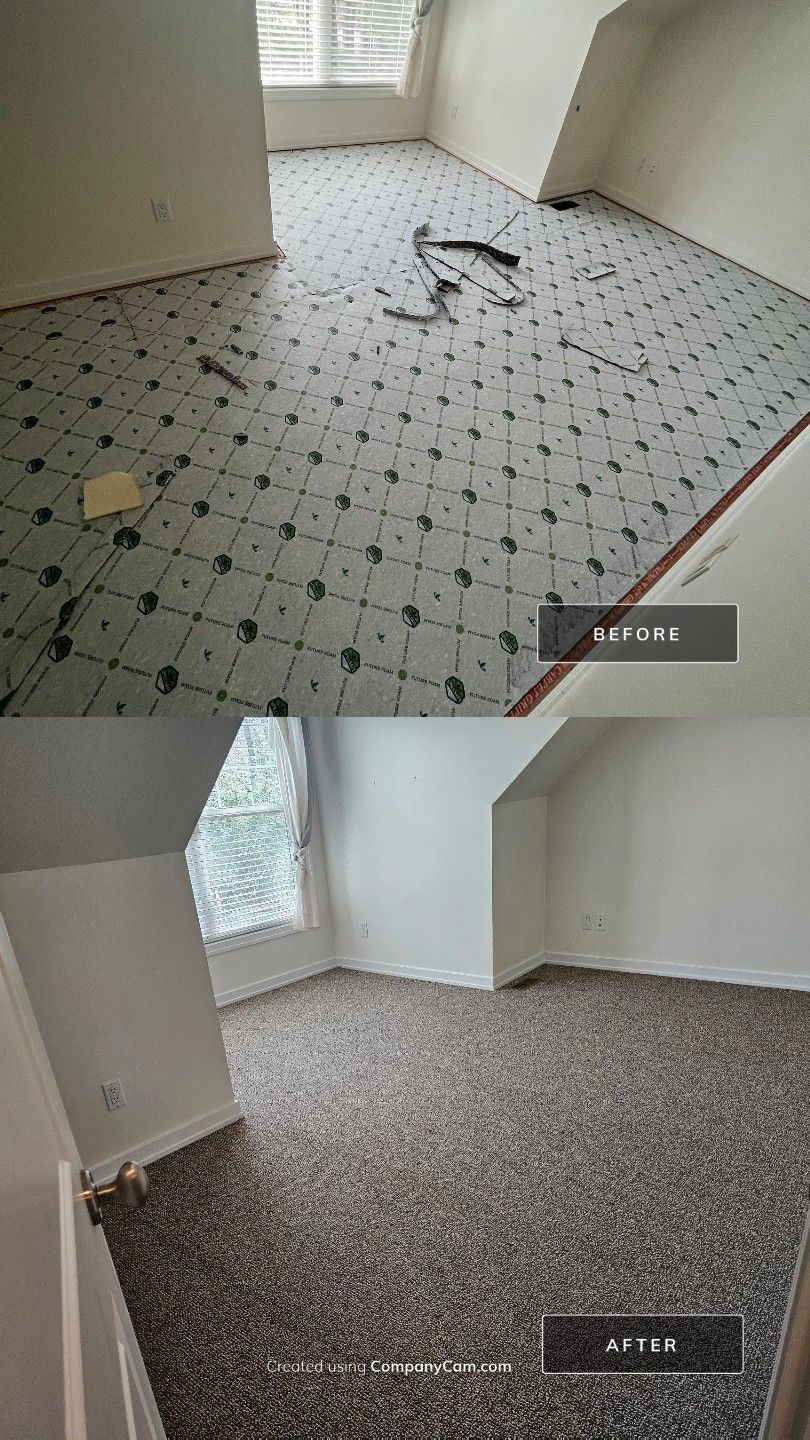
At the estimate, Nolan brings the carpet samples to your home, walks you through the pad options, measures every room and the stairs, checks the subfloor, and writes up the carpet, the pad, and the scope. On install day our crew moves through tear-out, subfloor checks, tack strip and pad, stretching, seams, and cleanup.
Our crew handles tear-out, disposal, and hauling, so there is no dumpster to schedule. Carpet is stretched across the room and trimmed at the walls, and transitions are set where carpet meets plank or tile. Ask where the seams will fall before install day, as the layout decides how visible they are.
One customer described her carpet job this way in a Google review: “I am extremely happy with the carpet installation. Angel and Salvador were efficient, careful, professional, and diligent, and the entire process went smoothly from start to finish.” (Irina Nadrau)
What should you ask a carpet installer?
Ask every installer the same eight questions and compare the answers in writing. The questions cover what carpet and pad are being quoted, who does the work, what the quote includes, and how the warranty is protected. An installer who answers all eight plainly is one you can hold to the estimate.
| Ask | A complete answer names |
|---|---|
| Which carpet is this quote for? | Brand, style name, fiber, and face weight |
| Which pad is included? | Type, thickness, and density |
| Does the pad meet the carpet warranty? | The warranty’s pad requirements, shown to you |
| Who installs it? | The crew that will be in your home |
| Is tear-out and disposal included? | Removal of old carpet and pad, and hauling |
| Who moves the furniture? | What the crew moves and what you clear beforehand |
| How are the stairs installed? | The method on the treads and how an open side is finished |
| Where will the seams fall? | A layout that shows seam locations before install day |
How do you care for new carpet?
Vacuum high-traffic areas often, blot spills right away instead of rubbing them, and follow the care instructions in the carpet warranty. Use mats at the doors through a Michigan winter, when salt and sand act like sandpaper on carpet fiber. Freedom Flooring installs carpet and does not offer carpet cleaning.
Keep the warranty paperwork with the estimate. It names the cleaning methods and the cleaning schedule the manufacturer expects, and following it is what keeps the warranty in force.
To compare samples at home, see Carpet Installation, browse carpet products, or start with Carpet Installation in Grand Rapids.
Book a free in-home consultation at freedomflooringmi.com or call (269) 390-6747.
Frequently Asked Questions
What is the most durable carpet fiber? Nylon and triexta are the most durable carpet fibers for homes. Both spring back under traffic, which makes them the usual choice for stairs, hallways, and family rooms. Polyester is softer and costs less but flattens sooner in heavy traffic.
What type of carpet is best for stairs? A dense, low to medium pile carpet in nylon or triexta is best for stairs, installed over a thin, firm pad and wrapped over each tread nose. Patterned and textured styles hide the traffic lane that forms down the middle of a flight.
Does a higher face weight mean better carpet? Face weight alone does not make a better carpet. Face weight is the ounces of fiber per square yard, and it only compares fairly between carpets of the same fiber and style. Density and twist say more about how a carpet will hold up on stairs and in hallways.
Can you put carpet in a basement in Michigan? Carpet can go in a Michigan basement when the slab has been tested and is dry. Use a synthetic fiber, a low pile, and a moisture-barrier pad. In a basement that takes on water or tests damp, waterproof plank is the better floor.
Does Freedom Flooring bring carpet samples to the house? Yes, Nolan brings carpet samples to your home across West and Southwest Michigan, walks you through the pad options, measures the rooms and stairs, and provides a written estimate. The in-home consultation is free.
Ready to see it in your home?
Nolan brings flooring samples directly to you. Book a free in-home consultation -- West and Southwest Michigan.
Book Free Consultation